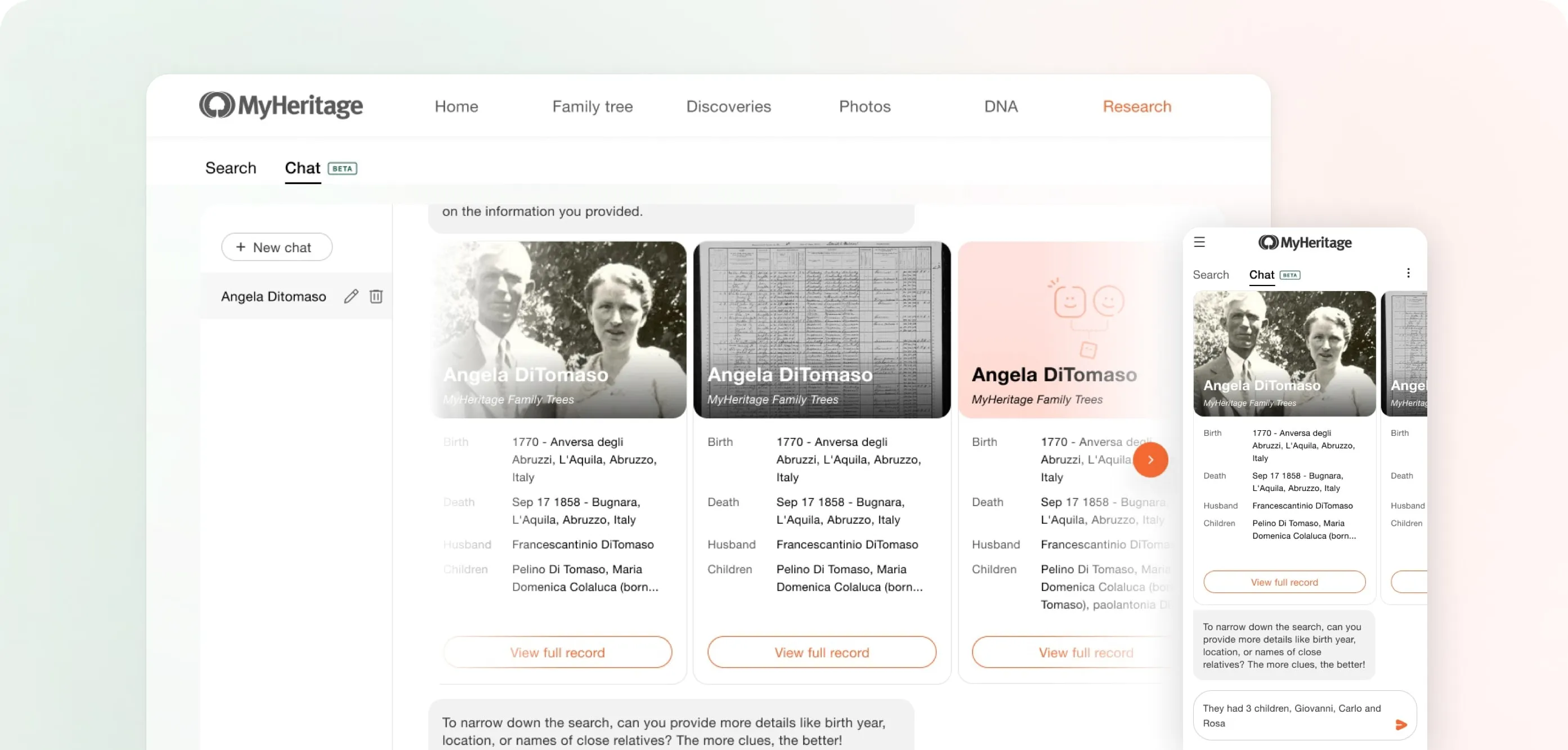
AI Historical Records Finder | MyHeritage
Reimagining historical search through conversational AI. Helping users go from data points to personal stories.
Background
AI Record Finder™ is a conversational search experience I designed at MyHeritage to help users explore billions of historical records through natural language and guided storytelling.
Traditional genealogy tools rely on structured queries and expert knowledge, creating a steep barrier for casual users, especially those who are emotionally curious but easily overwhelmed by data-heavy interfaces.
As the lead product designer, I collaborated closely with product, research, data, and engineering teams to reimagine historical discovery as an intuitive, story-driven journey.
- Role
- Product Designer - led end-to-end product design for viral AI feature, from research to launch.
- Platforms
- Desktop & Mobile
- Team
- Product designer, 2 PM, FE, QA
- Timeline
- 2023
The Problem
When curiosity meets complexity, motivation fades
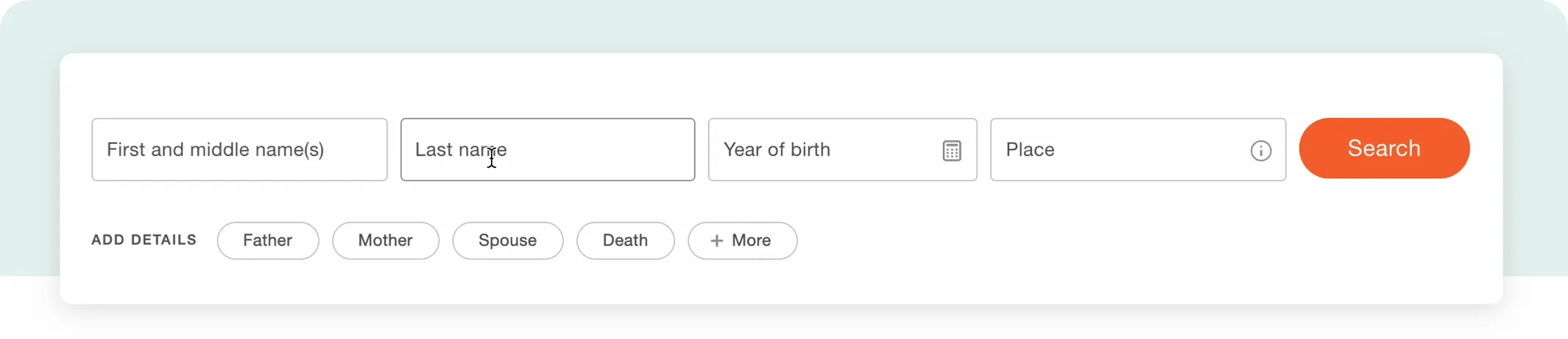
SuperSearch, MyHeritage’s traditional search engine, has been a cornerstone for experienced genealogists, yet overwhelming for casual users.
Through a UX audit and heuristic analysis, we mapped the major friction points:
- Manual field entry required domain knowledge and discouraged exploration.
- Most queries returned thousands of unfiltered results with little guidance.
- Users didn’t know which extra information could help refine the search.
- Relevant details were scattered across multiple records, often incomplete.
- Many users hit “dead ends” and abandoned their search out of frustration.
Current experience
Research
- 🧠 User Interviews
- 📱 Usability Testing
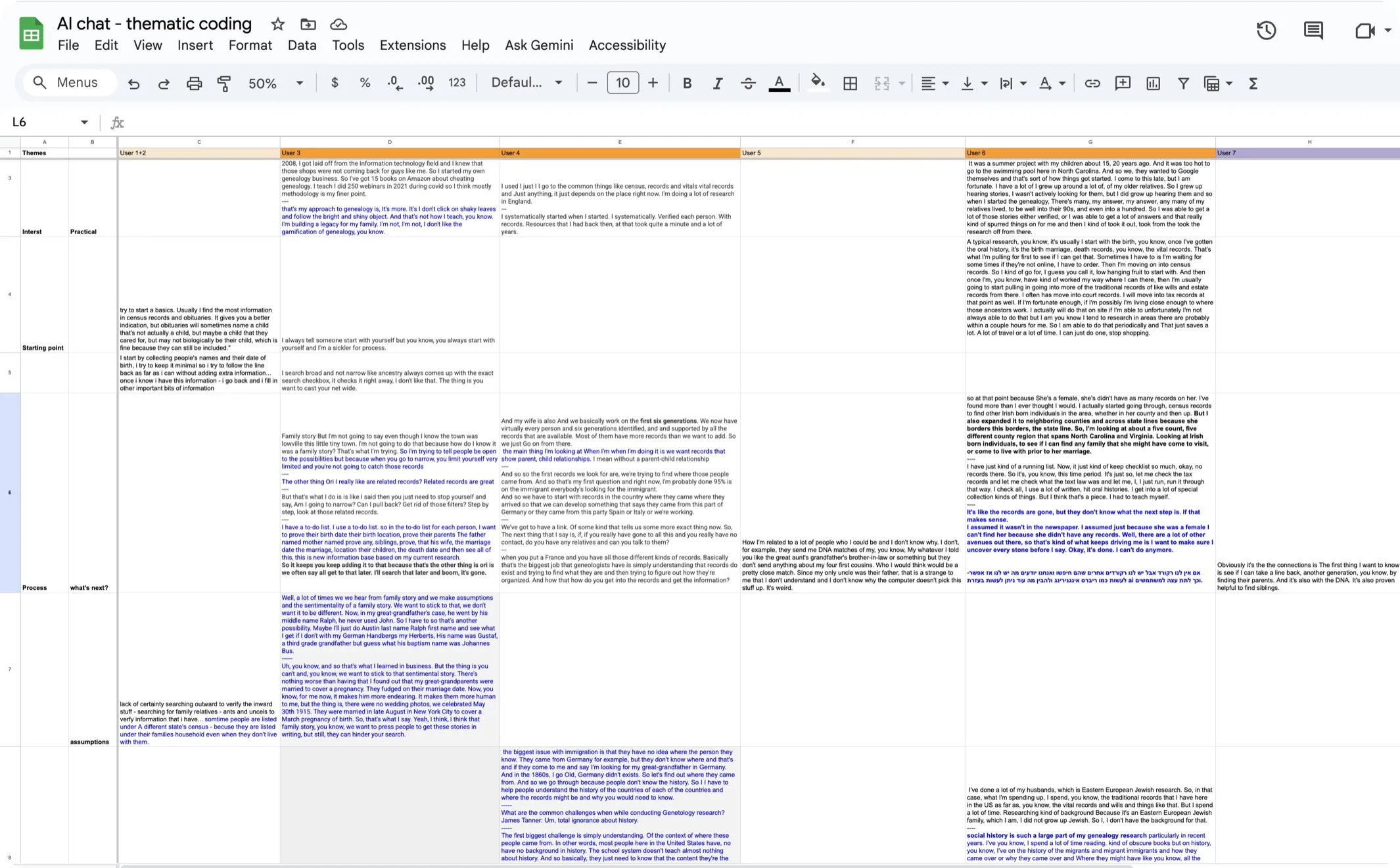
- 🧩 Thematic Coding
- 🗺️ Competitive Analysis
- 🧍 Personas
- 📊 Trend & Market Analysis
User Interviews
Understanding Our Users
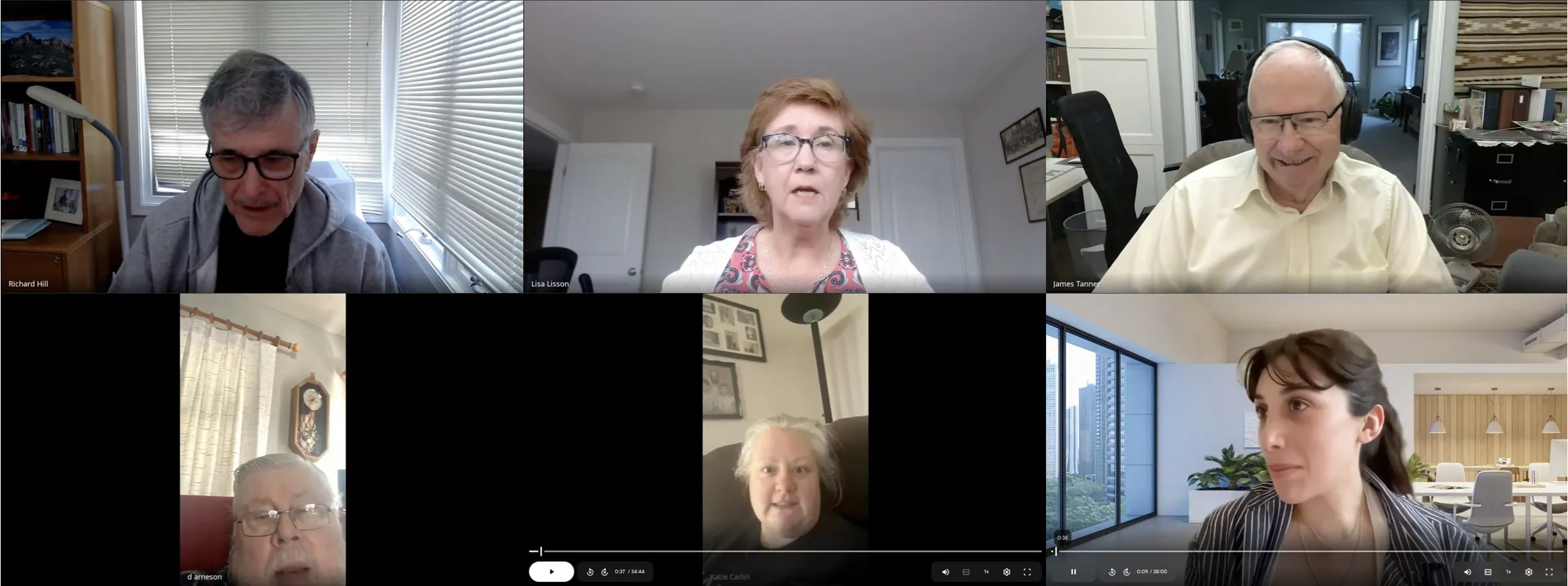
We conducted user interviews with a total of 10 participants of our target audience; including both genealogy experts, with years of experience in teaching genealogy research, and novice users who are simply curious about their family heritage.
We asked them about their past experiences with SuperSearch, about their strategies while conducting a genealogical research and about other tools they uses in order to discover pain points and opportunities. Following the interviews we conducted thematic coding to identify repeating patterns.
Personas I identified through user research

1# Persona
The focused investigator
Educated and curious, they dive into intellectually stimulating challenges, approaching tasks with thoroughness.
(Jennifer, 69)
“my Italian family tree is very hard to navigate, because everybody has the same names... I notice that on the Italian side of the family the woman retain their last name, which is not something that common and if you don't know the history of it - you don't even know that you need to look for it differently”

2# Persona
The carefree explorer
enthusiastic adventurers who prioritize creating memorable experiences, often juggle busy schedules and diverse interests.
(Dan, 47)
“If I am researching, you know, an ancestor from Ireland that ancestor from Germany, whatever. I don't always understand, if there's Somehow to tie in the piece of social history around it. Whether this is why they were, this is why, you know during this time period it was people commonly immigrated because of such and such...”

3# Persona
The family archivist
Elderly, traditional, history enthusiasts who favor simplicity and are not tech-savvy.
(Thomas, 75)
“When I can confidently add someone to my family tree and know without doubt that they truly belong there, that they’re mine, it gives me a real sense of accomplishment. Accuracy matters to me; getting it right is what makes the whole process so fulfilling.”
Main insights

Users crave confidence in their findings.
They seek narratives, not just facts.

They want to share the experience with their families.
Design Approach - Why We Chose AI?
Transforming complexity into conversation.
AI allowed us to reimagine the experience entirely:
- Users could speak naturally instead of filling structured forms.
- The system could ask intelligent follow-ups to guide exploration.
- AI could transform raw records into narratives with cultural context.
Thus, AI Record Finder™ emerged - an AI-powered assistant designed to help users locate ancestors and reveal the stories behind their data.
How Might We
leverage AI to create the ideal search experience on MyHeritage?
The Final Design
One record, one story, one clear moment of confidence.
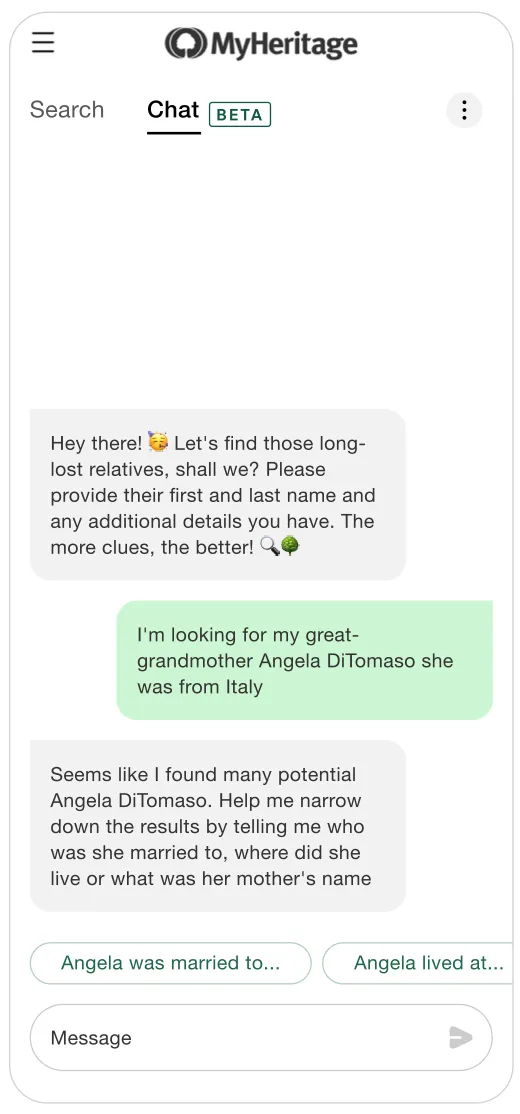
After multiple rounds of testing and iteration, we landed on a single-record conversational flow powered by MyHeritage’s “related records” network.
Users chat naturally, select one relevant record, and instantly receive an AI-generated biography containing:
- 🧬 Personal details
- 📖 Narrative summary
- 🕰️ Historical context
- 🌍 Last name origins
New Conversational Experience
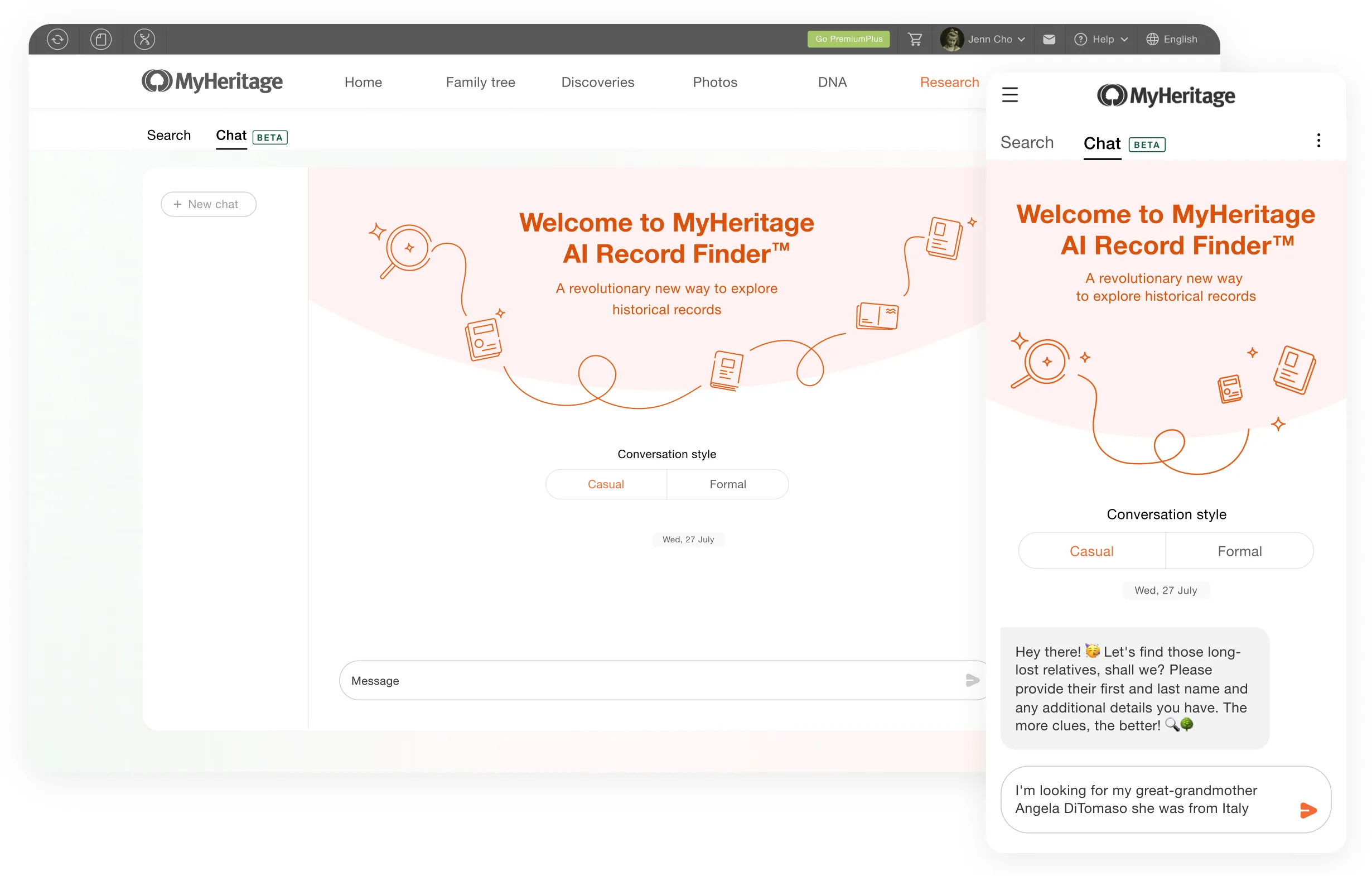
Why it works:
- Reduces cognitive load - no multi-record juggling.
- Delivers instant feedback and a sense of achievement.
- Directly fulfills users’ emotional need for accuracy and validation.
- Creates a sharable artifact that extends engagement beyond the platform.
Transforming data into meaningful narratives.
One of the strongest themes from our research was that users crave a complete story, not just records supported by historical and cultural understanding.
In our initial prototype, we introduced a “Story Message” feature: once users found a relevant person, they could access an AI-generated life story presented in a warm, engaging, and shareable format. This feature turned raw data into an emotional milestone - users could see and share their ancestors’ lives.
However, the “story” feature required significant cross-team resources. To validate its value and ship quickly, we launched a leaner MVP; a downloadable PDF divided into four simple sections: Personal Details, Biography, Historical Context, and Last Name Origins.
This familiar format, reminiscent of a Wikipedia-style family page resonated strongly with our core audience (aged 50–
90). It felt trustworthy, easy to read, and effortless to share with relatives.
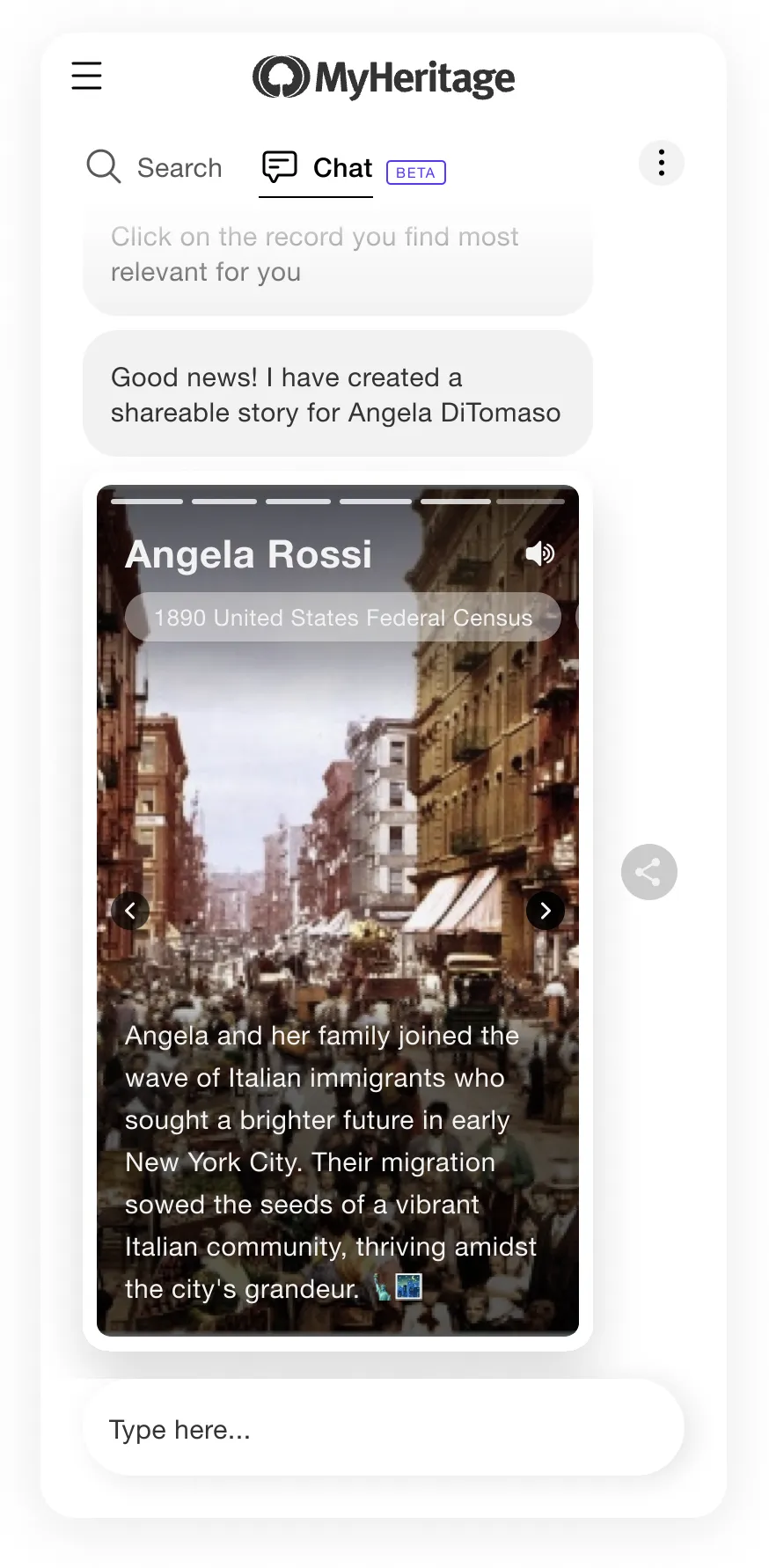
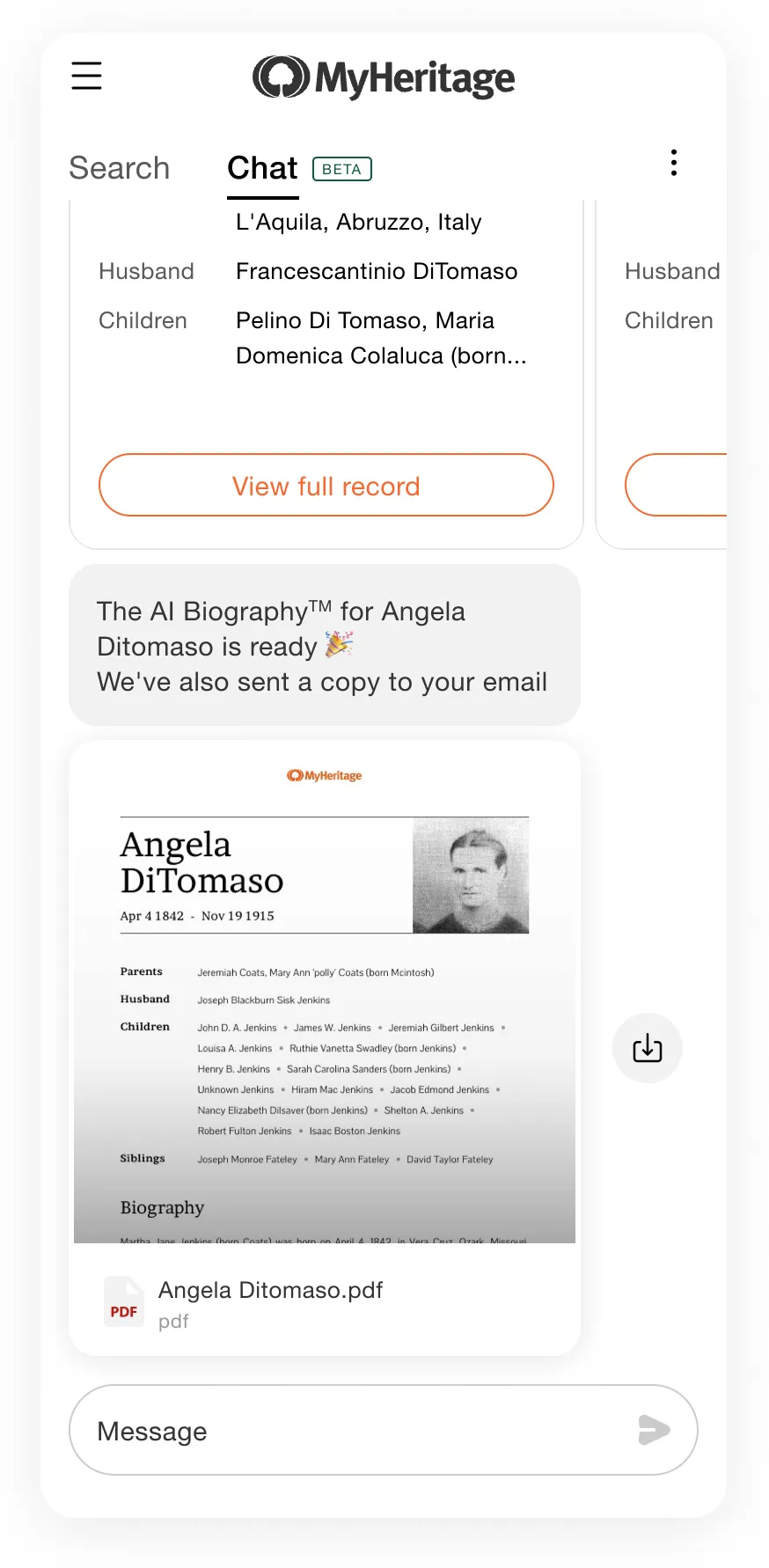
Users’ excitement around the biography led us to create a dedicated feature - AI Biography - with entry points across the product.
Since launch, it’s increased engagement by +25% and subscriptions by +18%, making storytelling a core part of the MyHeritage experience
Behind the Scenes - How We Got to the Final Flow
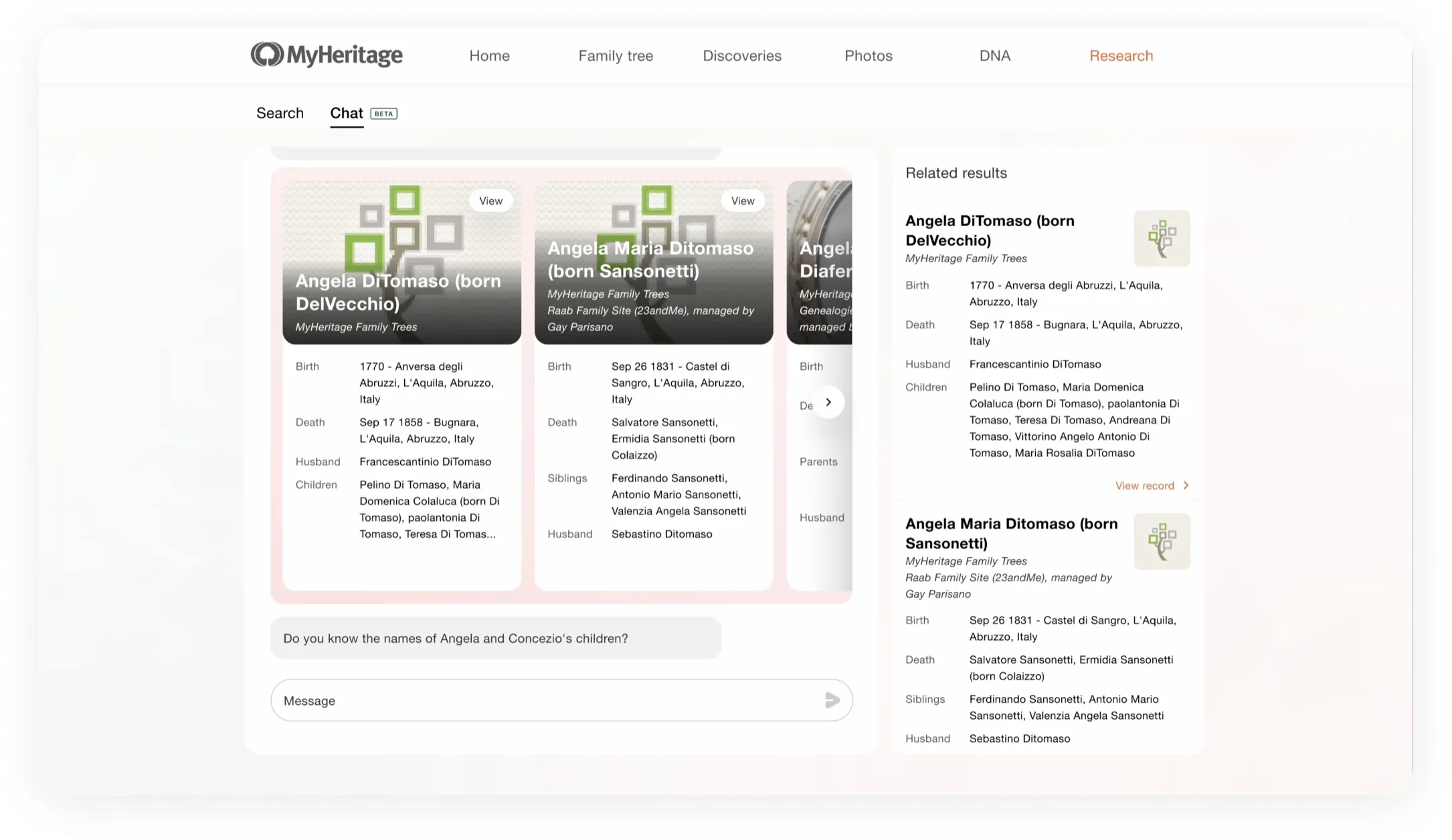
A. Dynamic Side-Panel Results (Dropped)
Goal: Keep conversation and search results visible at once.
Why We Tried It: Supported multitasking and transparency.
What We Learned:
- Users lost focus; two visual centers competed.
- Mobile adaptation failed due to screen constraints.
Decision: Cut - research showed clarity and focus trump visibility.
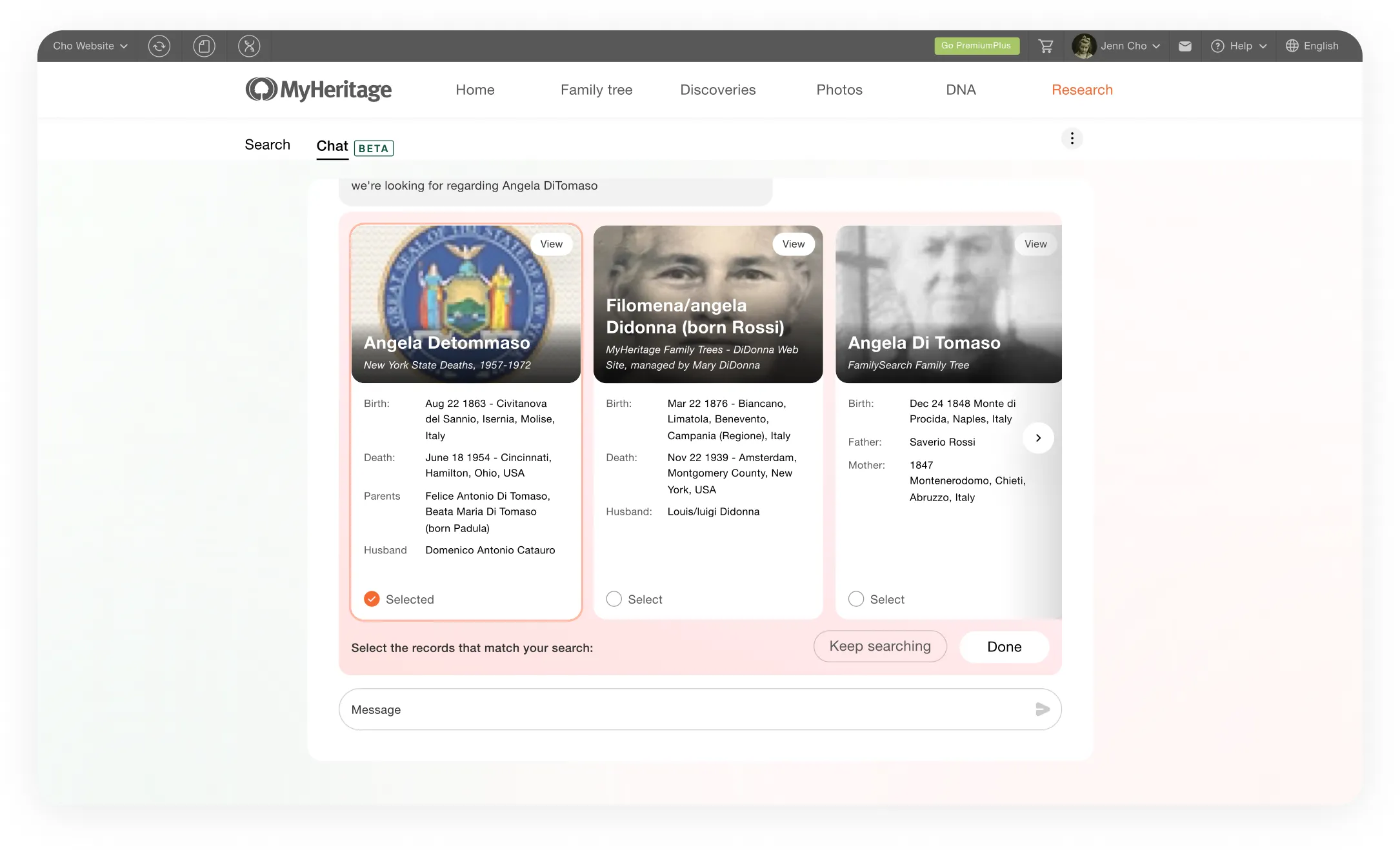
B. Multi-Record Selection (Simplified)
Goal: Let users select several records to form a narrative.
Why We Tried It: Historical storytelling often requires multiple sources.
What We Learned:
- Users didn’t grasp the difference between “Done” and “Continue chat.”
- Horizontal scrolling went unnoticed.
- People felt unsure what action would move them forward.
Decision: Simplify - users only need one confident choice, not five uncertain ones.
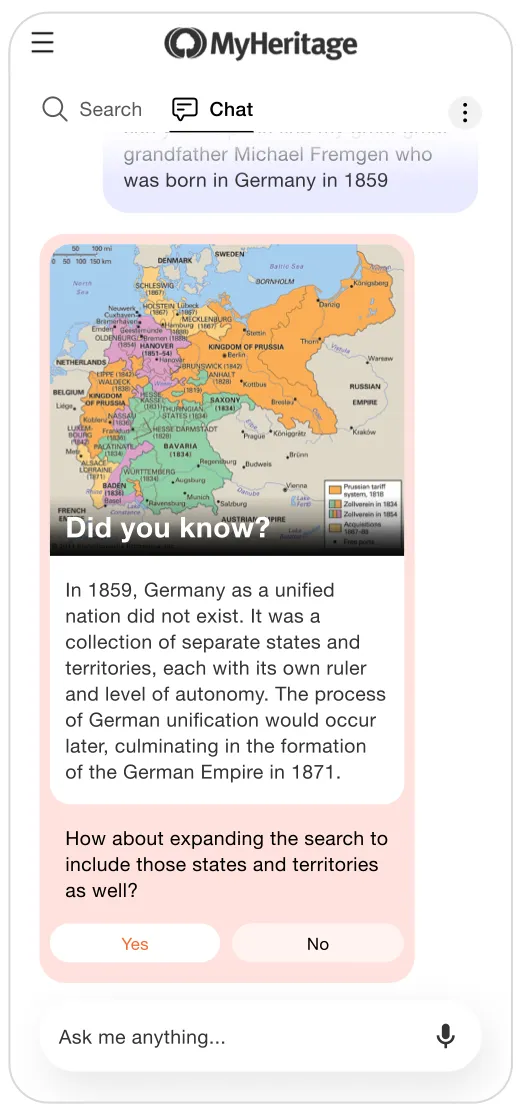
C. Smart Tags & “Fun Facts” (Post MVP)
Goal: Suggest contextual prompts and micro-insights to guide refinement.
Why We Tried It: Interviews showed users often don’t know what extra data helps.
What We Learned:
- Strong potential to educate and re-engage users mid-search.
- High technical cost and unclear MVP value.
Decision: Defer - planned for V2 once we validated the base flow.
Outcomes & Next Steps
The launch of AI Record Finder™ was an important step toward transforming genealogy research into a more conversational and intuitive experience. It helped us validate user interest in AI-assisted discovery and uncover key behavioral patterns around trust, accuracy, and storytelling.
While the technology at the time was still emerging, resulting in occasional fragmented or less accurate results, the project successfully demonstrated the potential of AI to simplify complex search tasks and humanize data exploration.
The biggest success to emerge from this work was AI Biography, which became a highly engaging, shareable storytelling feature loved by users. Its popularity confirmed that people connect most deeply to stories about their ancestors, not just records.
Today, as MyHeritage’s AI infrastructure continues to mature, we’re building Version 2 of AI Record Finder™, combining improved accuracy with the emotional depth of AI Biography creating a truly end-to-end discovery journey.
Takeaways and Lessons Learned
We set out to reimagine how people uncover their family stories, and in doing so, we laid the foundation for MyHeritage’s future of AI-driven discovery.
This project reminded me that meaningful innovation doesn’t always begin with perfection, it begins with curiosity, iteration, and a clear vision of what users truly value.
I’ve learned that:
Technology maturity shapes user value. Even the most elegant UX depends on what the underlying AI can truly deliver. AI Record Finder™ showed us where the limits were — and where the biggest opportunities would open once the models improved.
Experimentation drives progress. Testing an early
conversational prototype gave us real user feedback that data alone couldn’t reveal. It validated the desire for guidance and storytelling over raw search results.
Emotion outperforms output. Users connect more deeply with meaningful narratives than with lists of records. This insight directly inspired AI Biography, which became a loved and shareable features.
Iteration builds momentum. Rather than an endpoint, AI Record Finder™ became the starting point for MyHeritage’s AI storytelling ecosystem. Now, with more advanced technology, we’re developing Version 2 combining improved accuracy with the emotional depth of AI Biography to create a complete, story-first discovery journey.